
Real vs Fake Amethyst: 8 Easy Ways to Spot Original Amethyst
The amethyst stone has been one of the most admired purple quartz stones across the globe. Over the years, this stone has been widely used in rings, pendants, bracelets, exquisite necklaces and other jewellery pieces. Many buyers believe this stone has healing properties and buy it for several spiritual practices too. Belonging to the quartz family, this crystal comes in several purple hues, ranging from light lavender to dark violet shades.
Amethyst, being a healing crystal, is looked for by many people, as they believe it brings calmness, balance, and positive energy into the family. Because of its high demand in the jewellery market, there has been a strong inflow of fake gemstones. Potential buyers end up purchasing coloured glass, synthetic stones, and sometimes even dyed quartz, thinking they are buying a natural amethyst gemstone, but that’s not the case.
They confuse real amethyst with glass or synthetic stones, and for this reason, fake amethyst identification is a must these days. There has been a tight comparison for real vs fake amethyst, and especially for the first-time buyers, spotting the difference is almost impossible. With this article, we’ll help you with 8 easy ways to identify original amethyst and find out whether it is genuine or not.
H2: What is amethyst?
Amethyst is among the top purple varieties of quartz gemstones and was formed naturally inside the volcanic rocks thousands of years ago. The most fascinating thing about this stone is that it gets the purple shade from natural traces of iron, which are exposed to radiation during the formation. It comes in diverse hues of purple, such as lavender, violet and deep purple.
This is the reason why no two gemstones look alike. A majority of the original amethyst stones are found in Brazil, Uruguay, and Zambia. Any natural amethyst stone would rank 7 if it is measured on the Mohs scale of hardness, and because of this, they are worn in day-to-day jewellery pieces like rings and bracelets.
H2: Why is fake amethyst so common today?
In recent years, the demand for amethyst has increased a lot, not just for the jewellery purposes but also for the healing and spiritual practices. Because of social media, the crystal has been gaining widespread popularity, and for this reason, it has become incredibly difficult to identify a real amethyst. Buyers are often searching for affordable purple gemstones that have led to an increase in the production of fake gemstones.
As per the International Gem Society, many fake stones sold today are made using dyed quartz, coloured glass, or synthetic materials which clearly resemble a natural purple quartz. Online market scams make many fake stones look real at first glance and especially target those who are looking for genuine amethyst jewellery.
These are the reasons why understanding how to identify real amethyst has become important before buying any gemstone jewellery on any online platform or in offline stores.
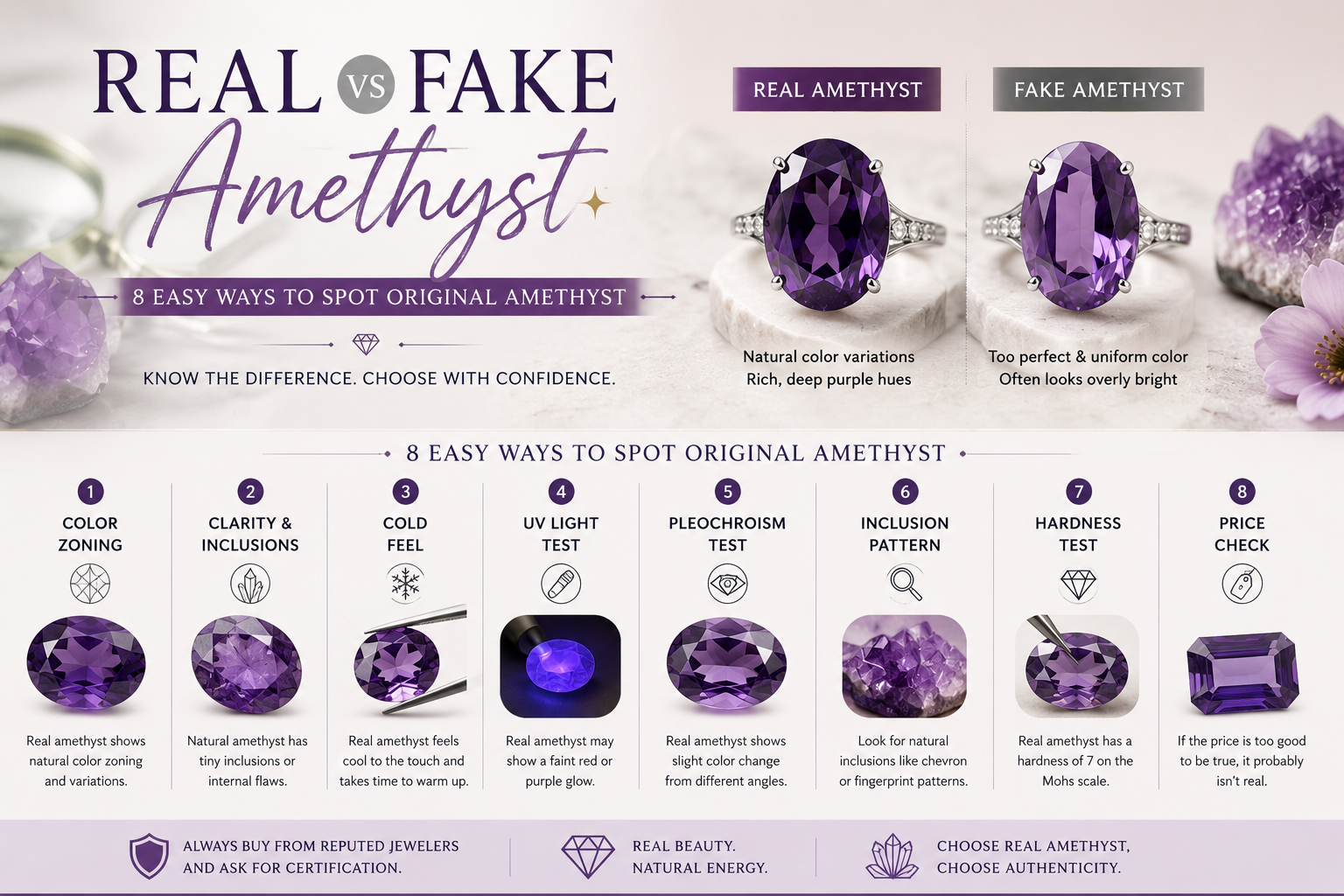
H2: 8 easy ways to spot original amethyst
Professional gemstone testing is one of the best ways to confirm if the gemstone is 100% authentic or not. If you are wondering how to identify a real amethyst among the fake ones, then by following these easy steps, you can really avoid common gemstone scams.
1. Check the colour zoning.
A real amethyst would be of different colours. All gemstones would have uneven colour distribution with no one flat shade. You’ll find them in lighter and darker hues of purple. A natural stone would have soft gradients, whereas the fake ones would look too perfect or neon purple.
2. Look for natural inclusions.
A flat, shaded stone with perfect clarity can be suspicious sometimes. A natural amethyst gemstone having tiny and natural inclusions on its surface is considered absolutely normal. But if your stone has air bubbles on the surface, it might indicate that the stone is made up of glass and is fake. To check this, use a magnifying glass or jeweller’s loupe.
3. Observe the transparency and shine.
A real amethyst would have a natural shine and would not poke you in the eyes. On the other hand, a fake gemstone may appear overly glossy, plastic-like or extremely bright. A natural amethyst’s balanced transparency does not make it look overly bright.
4. Try the temperature test.
Though the temperature test is not 100% accurate, it still helps you with the basic observations. During the conducting of this test, a real gemstone would stay cooler for a long time, whereas a fake one made with artificial glass can warm up really quickly.
5. Perform a careful scratch test.
You can also perform a scratch test to check how authentic your stone is. Amethyst ranks 7 on the Mohs hardness scale, so it can resist light scratches, as it is harder than ordinary glass. However, these methods require professional testing, and damaging jewellery is certainly not recommended.
6. Observe your gemstone under different lighting.
A real amethyst’s colour would be distributed. It means you can see uneven spots on different sides. Even if you examine it under different lighting, it would look really different in sunlight and indoor light. At the same time, a fake gemstone will appear bright under all types of lighting.
7. Check for dye concentration.
Gemstones which are fake and dyed will show concentrated colours near the stone’s edges and cracked lines. There will also be uneven artificial dye marks on the stone. This type of colour texture is very common in low-cost fake gemstones.
8. Buy from trusted gemstone sellers.
To avoid any scams, it is important to get such luxury gemstones from trusted sellers, as they avoid unrealistic pricing. You can also go through their certification, customer reviews, ratings and reputation to know how authentic they are. Experienced jewellery manufacturers like Valentine Silver International have years of gemstone expertise, and they follow trusted jewellery manufacturing practices.
H2: Real vs synthetic vs fake amethyst
Many buyers get confused while buying an amethyst, as a natural, synthetic and fake gemstone would all look similar in photos or jewellery displays. Let’s compare a real vs fake amethyst and understand a few differences to avoid scams later.
| Type of Amethyst | How Was It Formed? | How Does It Look? | What Value Does It Hold? |
| Natural Amethyst | Formed inside the Earth’s crust for years. | Every natural amethyst would vary in its colours; some might be of a dark shade, whereas others might be of a light shade. | Because they are rare and original, they are of extremely high value. |
| Synthetic Amethyst | These stones are created in labs. | A synthetic amethyst would look cleaner than the natural ones and have more uniformity in its structure. | Because they are lab-grown, they are more affordable and cheaper than the original ones. |
| Fake Amethyst | Prepared using glasses, stones, and plastics, all with fine durability. | Fake amethysts are bright-purple coloured and can look artificial too. | These are simply stones or plastics; thus, they have zero gemstone value. |
H2: Why is genuine amethyst valuable?
An original amethyst stone is very unique to other gemstones, and it stands out due to its beauty, durability and original colours. This stone’s demand is growing in markets over the year, and due to its eye-catching purple shade, amethyst continues to be one of the most valuable gemstones for buyers. Some other reasons that make this stone valuable are:
- Jewellery’s Beauty: Amethyst looks incredibly good when it is attached to a ring, a pendant, or a necklace, and it suits all classic, old and modern jewellery designs.
- Healing/ Spirituality Purposes: This gemstone is believed to calm and balance the energy around you and is used for healing and spiritual practices.
- Stone’s Durability: Amethysts are extremely durable gemstones, and they rank 7 on the Mohs scale of hardness. This makes it durable enough to be worn in daily life.
- Gemstone Collectors’ Frequent Demand: You will find this gemstone in multiple purple shades, and each one will have a different clarity that makes it different from the others. Due to its bright colour, it is very popular among gemstone collectors.
- Luxurious Appearance: Amethyst stone is majorly used in exquisite necklaces and selected jewellery collections due to its luxurious appearance.
H2: Tips for buying genuine amethyst jewellery
Purchasing an amethyst gemstone can become very easy if you know what details are to be checked before you make the purchase. A gemstone’s quality, effectiveness and whether it is a genuine one or not have to be identified by sparing some extra time while buying. Mentioned below are a few tips for buying genuine amethyst jewellery that can save you from scams.
- Ask for gemstone certification wherever required so that you learn about your amethyst’s quality.
- Always buy from reputable sellers and trusted jewellers because they will be more transparent about the gemstone quality, and they do not sell any fake gemstones.
- Before you make a purchase, please go through the return policies, as some sellers do not mention them, and if the gemstone fails the authenticity test, it will be difficult to send it back.
- Don’t rush to buy; first compare prices because extremely cheap-priced quartz can be a synthetic stone.
- Look at the finishing of the stones and inspect their craftsmanship. Sometimes, weak metalwork can indicate low-quality jewellery.
- Always research the amethyst’s source and where it is coming from. It usually has its origins in regions like Brazil, Uruguay, and Zambia.
Conclusion
As the demand for amethyst in the jewellery market grows, so does the production of fake gemstones. A majority of imitation stones look very similar to the natural ones and confuse the first-time buyers, especially on platforms like social media where it is very easy to convince the potential buyers. For this reason, it is very important to compare synthetic amethysts vs real ones. Before you buy, always examine the stones thoroughly. To avoid scams, many buyers prefer purchasing amethysts from experienced jewellery manufacturers like Valentine Silver International. This ensures that buyers invest in authentic craftsmanship and genuine gemstone quality instead of investing in the fake ones.