
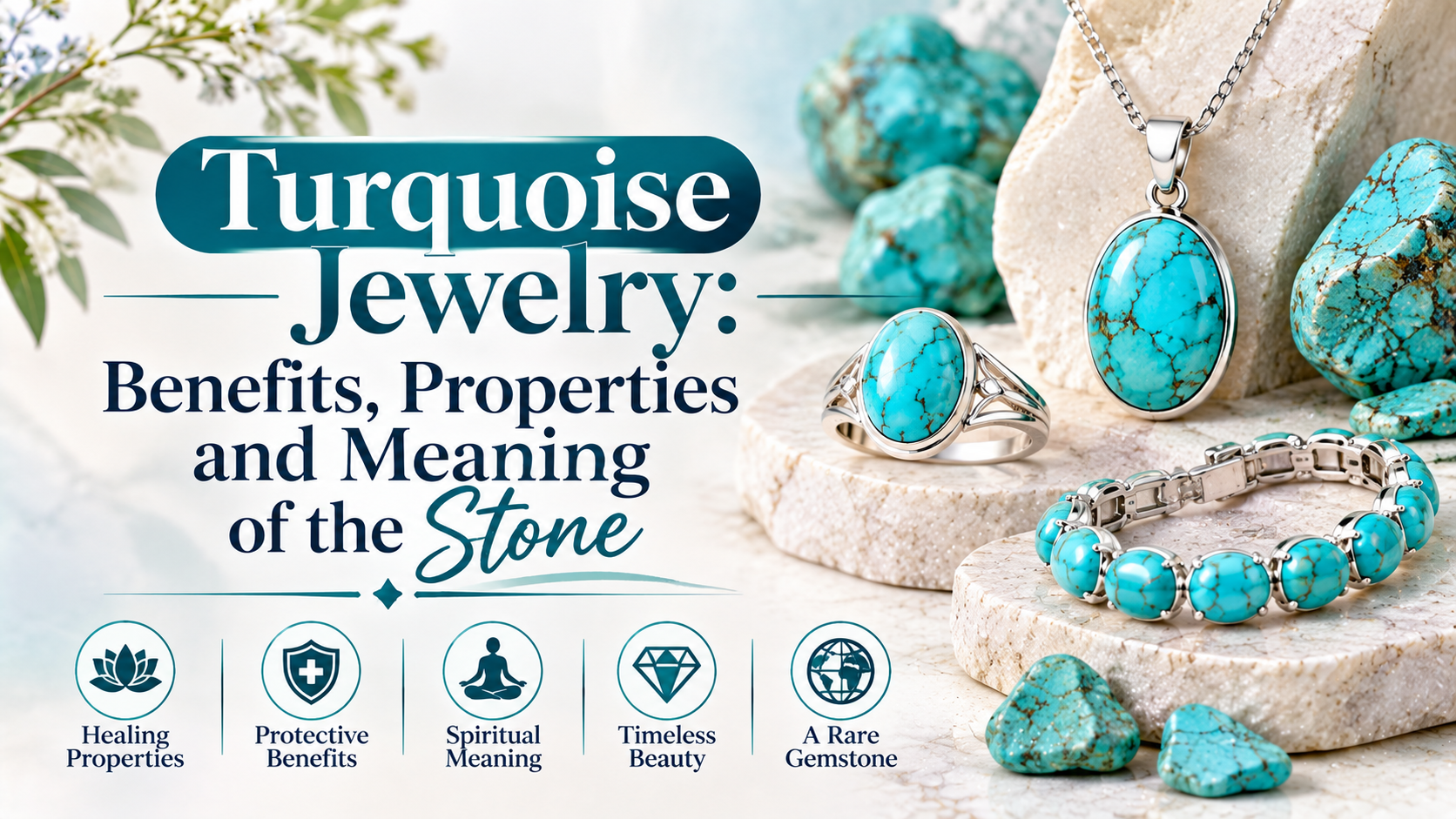
Turquoise Jewelry: Benefits, Properties and Meaning of the Stone
Turquoise is the only gemstone that gave its name to a color. You can’t say that about sapphire or emerald. Say “turquoise” to almost anyone in America and they picture the same thing: a soft sky blue with a hint of green, usually set in silver, often with fine dark lines running through it like a map.
We cut and set turquoise every week in our workshop in Jaipur, and it still surprises us. It’s soft, it’s moody, it reacts to the oils on your skin, and no two stones ever match exactly. It’s also one of the most faked gemstones in the world.
This guide covers what turquoise is, what it has meant to people for 7,000 years, and the benefits traditionally linked to it. It also covers the part most articles skip: how to tell real turquoise from fake, what makes one stone worth $20 and another $2,000, and how to care for turquoise set in sterling silver without ruining either one.
Turquoise at a Glance
| Property | Details |
| Mineral family | Hydrated copper aluminum phosphate |
| Chemical formula | CuAl₆(PO₄)₄(OH)₈·4H₂O |
| Color | Sky blue, robin’s egg blue, blue-green, green |
| What makes the color | Copper (blue), iron (green), sometimes zinc (yellow-green) |
| Hardness (Mohs) | 5 to 6 (softer than quartz, harder than glass in some cases) |
| Specific gravity | 2.6 to 2.9 |
| Refractive index | About 1.61 to 1.65 |
| Luster | Waxy to dull; takes a soft polish |
| Transparency | Opaque |
| Birthstone | December |
| Anniversary | 11th wedding anniversary |
| Chakra (traditional) | Throat chakra, also linked to heart and third eye |
| Zodiac (traditional) | Sagittarius, Pisces, Scorpio |
| Major sources | USA (Arizona, Nevada, New Mexico, Colorado), Iran, China, Tibet, Mexico, Egypt |
What Turquoise Actually Is
Turquoise is a mineral, not a crystal you’ll ever see as a pretty six-sided point. It forms as tiny, tightly packed microcrystals, which is why it looks opaque and waxy rather than sparkly.
It forms in dry places. In deserts, rainwater slowly trickles down through copper-rich rock, picking up copper, aluminum and phosphorus along the way. Over a very long time those minerals settle into cracks and cavities and harden into turquoise. That’s why the best deposits sit in arid regions like the American Southwest, the Iranian plateau and the Sinai.
Water is literally part of the stone’s chemistry. That one fact explains a lot about turquoise: why it’s porous, why it can change color, and why it hates heat and harsh chemicals.
Color: blue, green, and everything between
The color comes down to chemistry. More copper pushes the stone toward blue. More iron shifts it toward green. Some American and Chinese material leans yellow-green where zinc or extra iron is present.
There’s no single “correct” turquoise color, but the American market has long favored a clear, even sky blue, often called robin’s egg blue. Persian turquoise made that shade famous. Greener stones have a loyal following too, especially among collectors of Nevada material and Tibetan pieces.
Matrix: the lines that make each stone unique
The dark lines and patches in many stones are called matrix. Matrix is leftover host rock, usually iron oxides like limonite, chert or sandstone, caught up in the turquoise as it formed. It is not copper, despite what you’ll read on some sites.
Matrix can be black, brown, golden, reddish or even metallic. When it forms a fine, interlocking net, people call it spiderweb matrix, and in the right stone it’s among the most valuable turquoise on earth.
Clean, matrix-free stones and fine spiderweb stones can both sit at the top of the market. What lowers value is blotchy, crumbly matrix that weakens the stone.
A Short History of a Very Old Stone
Turquoise is one of the first gemstones humans ever mined, and its story runs across almost every continent.
Egypt. Egyptians mined turquoise in the Sinai Peninsula at least 5,000 years ago. Four bracelets found on the arm of a First Dynasty royal at Abydos, dated to around 3000 BC, include turquoise beads. They’re some of the oldest surviving jewelry in the world. The miners worshipped Hathor, whom they called the “Lady of Turquoise,” and built her a temple at Serabit el-Khadim right beside the mines.
You’ll often read that Tutankhamun’s gold mask is “studded with turquoise.” That’s not accurate. Its blue inlays are mostly lapis lazuli and colored glass.
Persia. The mines near Nishapur in northeastern Iran have produced turquoise for well over 2,000 years. The Persian word for the stone, pirouzeh (later firuzeh), is tied to the word for victory. Persians wore it to ward off unnatural death and set it into the hilts of daggers and horse bridles. The color found its way into architecture too: the turquoise-tiled domes of Isfahan are a nod to the stone’s sky-blue tradition.
Why we call it “turquoise.” The name comes from the French pierre turquoise, meaning “Turkish stone.” Persian turquoise reached Europe through Turkish markets, and Europeans named it after the place they bought it.
Mesoamerica. The Aztecs called turquoise xiuhuitl and treated it as a sacred material. Their turquoise mosaic masks and the famous double-headed serpent pectoral (now in the British Museum) are some of the most dazzling objects ever made from the stone. Much of their turquoise was traded south from what’s now New Mexico and Arizona.
The American Southwest. Ancestral Puebloan people mined turquoise in the Cerrillos Hills of New Mexico more than a thousand years ago. At Pueblo Bonito in Chaco Canyon, archaeologists recovered more than 50,000 pieces of turquoise. The stone was trade currency, offering and adornment all at once.
Tibet and the Himalayas. Turquoise is woven into Tibetan identity. It appears in prayer beads, headdresses, ritual objects and family heirlooms passed from mother to daughter. Tibetan turquoise tends to be greener and more heavily veined, and that look is prized locally.
Europe. Turquoise rings became fashionable among European men in the 1500s and 1600s. A court physician to the Holy Roman Emperor wrote in 1609 that a man’s hand wasn’t properly dressed without one. The Victorians loved it as a “forget-me-not” stone in sentimental jewelry.
Turquoise Meaning and Symbolism
Ask what turquoise means and you’ll get a different answer from every culture, but a few themes come up again and again.
Protection. This is the big one. Turkish horsemen tied turquoise to bridles to keep riders from falling. Persians wore it against the evil eye. Apache tradition says a turquoise fixed to a bow made the arrow fly true. Even today, many people wear turquoise when they travel.
Sky and water. Across the Southwest, turquoise is linked to the sky and to rain. Navajo stories tell of Changing Woman, sometimes called Turquoise Woman. Some tribes offered the stone in prayers for rain. Its color is the color of a clear desert sky above a riverbed.
Friendship and love. An old saying goes, “He who owns a turquoise will never want for a friend.” In parts of Asia, a turquoise received as a gift was believed to carry more luck than one you bought yourself. That’s a lovely reason to give it.
Wisdom and calm. Many traditions treat turquoise as a stone of clear thinking and emotional steadiness. The idea is simple: a stone the color of open sky helps you see further and worry less.
Life and good fortune. Because it stayed bright and sky-colored in tombs for thousands of years, turquoise came to stand for life, renewal and luck.
Turquoise Benefits and Properties
A quick, honest note before this section. The healing and spiritual benefits below come from centuries of tradition and from modern crystal practice. They are beliefs people hold, not medical facts, and turquoise jewelry is not a treatment for any health condition. If something is bothering your health, see a doctor. Wear turquoise because you love it and because the meaning speaks to you.
Emotional and mental benefits
Turquoise is traditionally seen as a calming, balancing stone. People who work with crystals describe it as helpful for:
- Easing everyday stress and nervousness
- Steadying mood swings
- Speaking up with confidence, especially for shy people or anyone who dreads public speaking
- Letting go of regret and being kinder to yourself
Many people simply find that wearing a stone they love, with a meaning they connect to, acts as a small daily reminder to breathe and stay grounded. That’s a real effect, even if it starts in your head rather than in the stone.
Spiritual and metaphysical properties
Throat chakra. Turquoise is most closely tied to the throat chakra (Vishuddha), the energy center linked to communication and honest self-expression. Wearing it as a necklace or choker keeps it near that point, which is why turquoise pendants are so popular in crystal circles.
Heart and third eye. Some practitioners also link it to the heart chakra for compassion and to the third eye for intuition.
Protection and purification. Turquoise is called a “protection stone” in nearly every tradition. Crystal practitioners believe it shields the wearer from negative energy.
Meditation. Holding turquoise during meditation is said to keep you grounded while you go deep.
Traditional physical associations
Older folk traditions linked turquoise to the throat, lungs, eyes and immune system. Medieval Europeans believed it would turn pale if its owner fell ill, or warn of poison. Some crystal books today repeat these associations. We include them for completeness and cultural interest, but they are not supported by medical evidence.
Turquoise benefits for women
Turquoise has long been worn by women as a stone of friendship, love and protection. Traditional associations include:
- Emotional balance and calm
- Confident communication at work and at home
- Protection for travel
- Strengthening relationships
There’s also the practical benefit: turquoise flatters nearly every skin tone. On warm or olive skin it glows; on fair skin it reads cool and crisp.
Turquoise benefits for men
For centuries turquoise was considered a man’s stone. Warriors wore it in Persia, Turkey and Mongolia, and Native American men have worn turquoise with silver for generations. Traditional associations for men include:
- Courage and steady nerves
- Clear judgment
- Leadership and honest communication
- Protection on the road
Style-wise, it’s one of the few stones that looks rugged rather than delicate, especially in a heavy silver ring or cuff.
Turquoise and the zodiac
In Western astrology, turquoise is a traditional stone for Sagittarius, which makes sense since it’s also a December birthstone. It’s also linked to Pisces and Scorpio, and some lists add Aquarius.
Its ruling planets are traditionally given as Venus and Neptune.
Turquoise in Islamic and Persian tradition
People often search for turquoise’s meaning in Islam. The stone, called firuzeh or feroza, has been cherished across the Muslim world for over a thousand years, especially in Persian, Turkish and Central Asian culture. Turquoise rings are worn as a sign of good fortune and protection, and there are sayings in popular tradition that praise it. Scholars debate how authentic some of these sayings are. What isn’t debated is how deeply the stone is woven into the region’s art, architecture and jewelry.
Who Should Not Wear Turquoise?
Physically, turquoise is safe for almost everyone to wear. The question usually comes from astrology, so here’s both sides.
From a belief standpoint: In Vedic astrology, turquoise (firoza) is often associated with Jupiter. Some astrologers suggest that people with certain chart placements check with an astrologer before wearing it. That’s a belief-based recommendation, not a physical risk.
From a practical standpoint, turquoise may not suit:
- People who never take their jewelry off. Constant soaking in showers, pools and dishwater can discolor turquoise. If you won’t remove a ring before washing up, choose a harder stone.
- People who work with their hands. Construction, gardening, climbing and gym work can chip or scratch a stone that’s only a 5 to 6 on the Mohs scale.
- Anyone with a metal allergy, if the setting is cheap alloy. It’s the metal, not the turquoise. Choose 925 sterling silver or solid gold.
- Anyone being sold turquoise as a health cure. If a seller promises it will treat an illness, walk away.
Does turquoise have negative effects?
There are no known physical side effects from wearing natural turquoise. The real “negatives” are practical:
- It can fade or turn greener over time.
- It scratches more easily than harder stones.
- Cheap jewelry is often fake or made with low-quality alloys.
Fix all three by buying from a trustworthy maker and following the care tips below.
Where Turquoise Comes From: The Famous US Mines
For American buyers, mine names matter. Collectors pay real premiums for turquoise from specific mines, and knowing a few of them helps you understand what you’re looking at.
| Mine | Where | What it looks like | Status |
| Sleeping Beauty | Globe, Arizona | Clear, even sky blue with little or no matrix. The classic “robin’s egg” look. | Stopped producing turquoise in 2012. Existing stock is still traded. |
| Kingman | Mohave County, Arizona | Bright blue, sometimes with black or quartz matrix. One of the oldest and largest US sources. | Still produces. Much of it is stabilized. |
| Bisbee | Bisbee, Arizona | Deep blue with chocolate-brown or reddish matrix. | Came from a copper pit that closed in the 1970s. Highly collectible. |
| Morenci | Greenlee County, Arizona | Blue with shiny pyrite matrix that looks almost silver. | Largely mined out. |
| Number 8 | Near Carlin, Nevada | Blue to green with golden-brown or black spiderweb matrix. | Mined out in the 1970s. Very collectible. |
| Lander Blue | Lander County, Nevada | Deep blue with fine black spiderweb matrix. | A tiny deposit found in 1973 and quickly exhausted. Among the most valuable turquoise in the world. |
| Royston | Near Tonopah, Nevada | Blue to deep green, often both in one stone, with golden-brown matrix. | Still produces in small amounts. |
| Cerrillos | Near Santa Fe, New Mexico | Blue to green, often with tan matrix. | Mined for over 1,000 years. Little produced today. |
Outside the US: Iran remains famous for clear sky-blue stones from Nishapur. China is now the world’s largest producer, with a wide range of quality. Tibet, Mexico and Egypt also produce turquoise, each with its own look.
A fair warning: mine names get misused. “Sleeping Beauty” is sometimes attached to any clear blue stone. If a seller names a mine, ask how they know.
Real, Stabilized, Reconstituted or Fake?
This is the most important section in this guide. Most turquoise sold in the world today is treated, and a lot of “turquoise” isn’t turquoise at all. That’s not automatically bad. It just needs to be disclosed so you pay the right price.
The five types you’ll see
| Type | What it is | Is it real turquoise? | What it means for you |
| Natural | Cut and polished, nothing added. | Yes | The rarest and most valuable. Only good-quality, naturally hard rough can be used this way. |
| Stabilized | Softer natural turquoise infused with clear resin to harden it and lock in color. | Yes, treated | The most common kind in jewelry. Durable and attractive. Should cost less than natural. |
| Enhanced (Zachery process) | A treatment developed in the 1980s that improves hardness and color. Hard to detect without a lab. | Yes, treated | Should be disclosed and priced as treated. |
| Reconstituted | Turquoise powder or chips mixed with resin and pressed into blocks. | Partly. It’s mostly binder. | Low value. Often has a too-perfect, uniform color. |
| Imitation | Another material made to look like turquoise: dyed howlite, dyed magnesite, plastic, glass or a lab-made simulant. | No | Should be very cheap and clearly labeled. |
Stabilized turquoise is honest jewelry when it’s sold as stabilized. Most turquoise mined today is too soft and chalky to cut without help, and stabilizing makes it wearable. The problem is when treated or fake material is sold as natural at natural prices.
Watch out for these misleading names
Some names sound like turquoise but aren’t:
- African turquoise: a green, speckled jasper.
- Peruvian turquoise: usually chrysocolla or another copper mineral.
- White turquoise / “white buffalo”: generally magnesite or howlite, not turquoise.
- Yellow turquoise: usually jasper or magnesite.
These can all be beautiful stones. They just aren’t turquoise and shouldn’t be priced like it.
Simple checks you can do at home
None of these is foolproof, and the most convincing fakes can fool experienced dealers. But together they’ll catch most of the junk.
- Check the price. Natural, untreated turquoise in a well-made silver setting is not cheap. A large, bright “genuine turquoise” ring for $15 is almost certainly dyed or reconstituted.
- Look at the matrix up close. In dyed howlite and magnesite, the dye pools in the cracks, so the “veins” look dark and sunken. The color around them can look flat and painty. Natural matrix varies more and blends into the stone.
- Look inside drill holes and chips. On beads, peek into the hole. A white or pale core under blue color means a dyed stone.
- Compare beads on a strand. If every bead has nearly identical color and veining, you may be looking at reconstituted block or plastic. Nature doesn’t repeat itself that neatly.
- Try a gentle dye test, only on a loose bead you own. Dab a cotton swab with nail polish remover on a hidden spot. If blue comes off on the cotton, it’s dyed. Skip this on finished jewelry and stabilized stones, since solvents can dull resin.
- Feel the weight and temperature. Plastic imitations feel light and warm up quickly in your hand.
Don’t try the “hot needle test” you’ll see online. It damages the stone and proves very little.
For anything expensive: ask for a lab report. Gemological labs like GIA can identify natural, stabilized, enhanced and imitation turquoise. Any seller asking serious money for “natural” turquoise should be comfortable with that.
Native American Turquoise Jewelry and the Law
In the US, turquoise and silver is closely tied to Navajo, Zuni, Hopi and Pueblo artists. That heritage is real, and it’s protected by law.
The great Southwestern traditions
Navajo (Diné) silversmiths started working metal in the mid-1800s, learning from Mexican smiths. By around the 1880s they were setting turquoise into silver. Navajo work is known for bold stones, heavy silver, stamped designs, cluster pieces and the iconic squash blossom necklace.
Zuni artists are famous for precise lapidary work. Their styles include needlepoint and petit point (dozens of tiny hand-cut stones set side by side), plus inlay and channel work.
Hopi jewelers developed silver overlay, where a design is cut out of one silver sheet and soldered over another. It uses less turquoise but deserves a mention because of its importance.
Santo Domingo (Kewa) Pueblo artists are known for heishi, fine strands of hand-rolled shell and stone beads, often including turquoise.
The Indian Arts and Crafts Act
The Indian Arts and Crafts Act of 1990 makes it illegal to sell or display any product in a way that falsely suggests it was made by a Native American or by a member of a particular tribe. Penalties for a first violation can reach $250,000 and five years in prison for individuals, and up to $1,000,000 for businesses.
What that means for you as a shopper:
- “Native American made,” “Navajo” or “Zuni” should mean exactly that, and an honest seller can tell you the artist or tribal affiliation.
- “Southwest style,” “Western style” or “boho” means the design is inspired by that tradition, not made by Native artists.
- Both can be lovely. You should just know which one you’re buying.
We make turquoise jewelry in Jaipur, so ours is never sold as Native American. It’s Southwest-inspired and Indian-made, and we say so. We think that kind of plain labeling is what this market needs more of.
How to Judge Turquoise Quality and Value
There’s no official grading system for turquoise the way there is for diamonds. Dealers weigh a handful of factors together.
- Natural vs. treated. This is the biggest price factor. Natural, untreated turquoise of good quality can cost many times what a similar-looking stabilized stone costs.
- Color. Even, saturated color sells best. In the US market, an intense, clear blue usually commands the most, though top greens from Nevada have devoted buyers. Pale, chalky or blotchy stones are worth less.
- Matrix. Clean stones and fine, tight spiderweb stones both sit at the top. Coarse, crumbly or patchy matrix lowers value.
- Hardness. Hard, dense turquoise takes a better polish and holds its color. Soft, chalky turquoise usually needs stabilizing.
- Mine of origin. A verified Lander Blue or Number 8 stone can sell for a large premium over an unnamed stone of similar looks.
- Size and cut. Bigger, well-shaped stones with no cracks cost more.
- Craftsmanship. The silverwork matters too. A clean, sturdy bezel, solid sterling and careful finishing make a piece last, and they add real value.
A rough price picture
Turquoise has one of the widest price ranges of any gemstone. A simple stabilized turquoise pendant in sterling silver can sell for under $100. Signed pieces by known Native American artists using natural stones from famous mines can reach thousands of dollars. Most of what you’ll see in stores falls between those two, and the factors above explain where a piece sits.
Why Turquoise and Sterling Silver Belong Together
Turquoise looks good in gold. It looks right in silver.
Part of it is color. The cool white of sterling silver sharpens turquoise’s blue, while yellow gold warms it and pushes it toward green. Part of it is history. Southwestern silversmiths built a whole visual language around silver and turquoise over the last 150 years, and that look is now baked into American style.
There’s a practical side too. Turquoise is soft, so it needs a protective setting. A silver bezel wraps around the edge of a cabochon and shields it from knocks. Sterling silver (92.5% pure silver) is strong enough for a secure bezel and soft enough for fine hand-finishing.
At our workshop we cut turquoise in-house, which lets us shape each cabochon to its setting instead of forcing a stone into a standard frame. A snug fit is what keeps a soft stone safe for decades. It’s a small detail, but it’s the one we see go wrong most often in cheaper pieces.
How to Style Turquoise Jewelry
Turquoise is easier to wear than people think. Here’s what works.
For everyday: Small turquoise studs or a slim stacking ring go with almost anything. A single pendant on a fine silver chain looks great with a white tee or a crisp button-down.
With denim: Turquoise and denim are a classic American pairing. Try a cuff or a chunky ring with a denim jacket.
With neutrals: Turquoise really sings against cream, camel, tan, white, black and chocolate brown. If your wardrobe is mostly neutral, turquoise is the easiest way to add color.
Color pairings: Red coral is the traditional Southwest partner. Black onyx, mother-of-pearl, garnet and carnelian also look striking next to it.
Mixing metals: Turquoise sits naturally with silver, but a touch of gold or rose gold in a stack makes it feel more modern.
For men: A turquoise signet or cushion ring in heavy sterling, a cuff, or a beaded bracelet stacked with onyx and tiger’s eye. Keep the stones solid and the silver weighty.
For special occasions: A turquoise statement necklace with a simple dress lets the stone do the talking. “Something blue” turquoise earrings are a lovely bridal touch.
For summer: Turquoise looks at home on the beach, at a pool party or anywhere sunny. Just take it off before you swim.
Turquoise as a Gift: December Birthstone and 11th Anniversary
December birthstone. Turquoise is one of December’s official birthstones, alongside tanzanite and zircon. It’s the traditional choice and the one with the deepest history. It’s a natural pick for anyone born in December, and for Sagittarius birthdays.
11th wedding anniversary. Turquoise is the traditional gemstone for an 11th anniversary. With its old meanings of protection, loyalty and friendship, it’s a thoughtful choice for a marriage well past the honeymoon stage.
Gifts with meaning. Remember the old belief that turquoise brings more luck when it’s given than when it’s bought for yourself. That makes it a great present for:
- A best friend moving away
- A graduate starting a new chapter
- Someone about to travel
- Anyone who could use a little protection and calm
How to Care for Turquoise and Silver Jewelry
Turquoise is porous and fairly soft, and silver tarnishes. Here’s how to keep both looking good for decades.
Everyday habits
- Put it on last, take it off first. Apply lotion, perfume, sunscreen and hairspray before putting on turquoise jewelry. These can soak in and discolor the stone.
- Remove it before water. Take it off before showering, swimming (chlorine and salt water are both bad for it), doing dishes or cleaning.
- Remove it for workouts and manual work. Sweat can discolor turquoise, and knocks can chip it.
- Keep it away from heat. Don’t leave turquoise on a sunny windowsill or in a hot car. Heat can dry it out and change its color.
How to clean turquoise jewelry
- Wipe the stone gently with a soft, slightly damp cloth.
- If needed, use a tiny drop of mild dish soap in lukewarm water on the cloth. Don’t soak the piece.
- Dry it right away with a soft, lint-free cloth.
Never use an ultrasonic cleaner, a steam cleaner, ammonia, bleach or harsh jewelry cleaners on turquoise.
How to clean the silver without hurting the stone
This is where people get into trouble. Liquid silver dips and most silver polishes are acidic and can permanently damage turquoise.
- Use a silver polishing cloth on the metal only, working carefully around the stone.
- For detailed areas, a soft dry toothbrush helps.
- Never dunk turquoise jewelry in silver dip, and keep polish paste off the stone.
Storage
- Store each piece separately in a soft pouch or lined jewelry box so harder gems don’t scratch it.
- Anti-tarnish pouches or strips slow silver tarnish a lot.
- Keep pieces out of the bathroom, since humidity speeds up tarnish.
Will my turquoise change color?
It might, and that’s normal. Untreated turquoise can slowly darken or turn greener as it absorbs skin oils. Some collectors love this patina. Stabilized turquoise is far more color-stable.
If a stone feels loose in its setting, get it checked by a jeweler before it falls out.
Energetic cleansing
If you use turquoise in crystal practice, choose gentle cleansing methods: moonlight, sage or palo santo smoke, or sound from a singing bowl. Skip soaking in water and leaving it in direct sun, which some crystal sites suggest. Those methods can physically damage the stone.
For Brands: Building a Turquoise Jewelry Line
If you run a jewelry brand or boutique in the US, turquoise is one of the most reliable sellers in silver. It’s also a stone where sourcing honesty matters more than usual.
At Valentine Silver International in Jaipur, our gem cutters work alongside 800+ artisans. We handle turquoise from rough to finished piece: in-house sourcing and cutting, sterling silver casting and hand-setting. Every stone is labeled by type (natural, stabilized or otherwise), so your product descriptions can be accurate from day one.
You can browse our collection, read about our responsible sourcing practices, or start a custom order for your own turquoise designs.
Turquoise FAQs
What does turquoise symbolize?
Turquoise symbolizes protection, friendship, wisdom, good fortune and a connection between earth and sky. Its meanings show up across Egyptian, Persian, Native American, Aztec and Tibetan traditions.
What does wearing turquoise attract?
Traditionally, turquoise is said to attract good luck, loyal friendships, calm and protection. In crystal practice it’s also linked to confident, honest communication.
Why is turquoise considered so powerful?
It’s one of the oldest gemstones humans have worn, it held sacred status in dozens of cultures, and its sky-and-water color carries strong symbolic meaning. Its spiritual reputation comes from that long history.
Which zodiac sign should wear turquoise?
Sagittarius is the strongest traditional match, partly because turquoise is a December birthstone. Pisces and Scorpio are also traditionally linked to it.
Is it okay to wear turquoise every day?
Yes, if you take it off for showers, swimming, workouts and cleaning, and put it on after lotions and perfume. Stabilized turquoise in a sturdy silver bezel holds up especially well to daily wear.
Can turquoise get wet?
A quick splash won’t hurt it, but don’t soak it or wear it in the shower, pool or ocean. Water, soap, chlorine and salt can discolor the stone over time.
Why did my turquoise turn green?
Natural, untreated turquoise can absorb skin oils, lotions and moisture, which can slowly shift its color toward green. Stabilized turquoise is much less likely to change.
Is stabilized turquoise real turquoise?
Yes. Stabilized turquoise is natural turquoise that has been infused with resin to make it harder and more color-stable. It should be disclosed and priced lower than natural, untreated turquoise.
How can I tell if my turquoise is real?
Check the price, look for dye pooling in cracks, look inside drill holes for a white core, and compare beads for overly identical patterns. For expensive pieces, ask for a gem lab report.
Is turquoise expensive?
It ranges widely. Stabilized turquoise jewelry can be very affordable, while natural turquoise from famous mines such as Lander Blue or Number 8 can cost thousands of dollars.
Can men wear turquoise?
Absolutely. Turquoise has been a men’s stone for centuries, from Persian warriors to Navajo silversmiths. Rings, cuffs and beaded bracelets are the most popular men’s pieces.
What chakra is turquoise for?
Turquoise is mainly associated with the throat chakra, which governs communication and self-expression. Some practitioners also link it to the heart and third eye chakras.
Is turquoise a birthstone?
Yes. Turquoise is a traditional December birthstone, and it’s also the gemstone for the 11th wedding anniversary.
Does turquoise have any negative effects?
There are no known physical side effects from wearing natural turquoise. Some astrologers advise checking your chart first. The practical downsides are that it’s soft, it can fade, and it’s often faked.
Does turquoise go better with silver or gold?
Both work, but silver is the classic pairing. Its cool tone brightens turquoise’s blue, while gold warms it toward green.